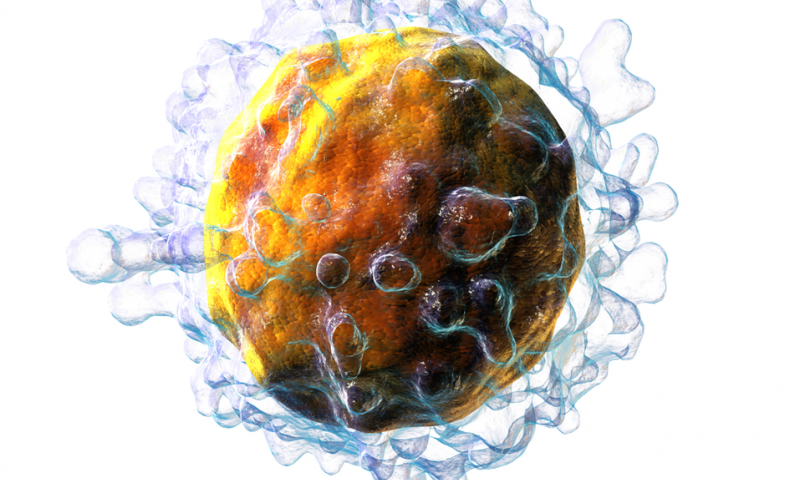
 "3D rendering of a T cell. Credit: CC BY 3.0, Blausen.com staff. "Blausen gallery 2014". Wikiversity Journal of Medicine. DOI:10.15347/wjm/2014.010. ISSN 20018762." How do immune cells remember an infection or a vaccination so that they can spring into action decades later? Research led by scientists at the University of California, Berkeley, in collaboration with investigators at Emory University, has found an answer: A small pool of the same immune cells that responded to the original invasion remain alive for years, developing unique features that keep them primed and waiting for the same microbe to re-invade the body. Before this study, scientists were not sure how cells can remember an infection from up to 30 years earlier. To tease apart this mystery, the research team tracked a specific kind of immune cell through the human body in the weeks, months and years following a vaccination that gives long-term protection. The researchers tracked T cells inside people's bodies after they were given the long-lasting yellow fever virus vaccine, using a technology developed at Berkeley for monitoring the birth and death of cells in humans over long periods of time. The researchers found that CD8+ T cells, responsible for long-term immunity against yellow fever, proliferate rapidly on exposure to the vaccine but then evolve, beginning about four weeks after the vaccination, into a "memory pool" of cells that live more than 10 times longer than the average T cell. More information: Rama S. Akondy et al. Origin and differentiation of human memory CD8 T cells after vaccination, Nature (2017). DOI: 10.1038/nature24633 Journal reference: Nature Source: phys.org ¿Cómo recuerdan las células inmunitarias una infección o una vacuna para que puedan entrar en acción décadas después? La investigación dirigida por científicos de la Universidad de California en Berkeley y en colaboración con investigadores de la Universidad de Emory, encontró una respuesta: un pequeño grupo de las mismas células inmunes que respondieron a la invasión original permanecen vivos durante años, desarrollando características únicas que los mantienen preparado y esperando que el mismo agente re-invada el cuerpo.
Antes de este estudio, los científicos no estaban seguros de cómo las células pueden recordar una infección de hasta 30 años. Para desentrañar este misterio, el equipo de investigación rastreó un tipo específico de célula inmune a través del cuerpo humano en las semanas, meses y años posteriores a una vacuna que brinda protección a largo plazo. Los investigadores rastrearon las células T dentro de los cuerpos de las personas después de que recibieron la vacuna duradera contra el virus de la fiebre amarilla, utilizando una tecnología desarrollada en Berkeley para monitorear el nacimiento y la muerte de las células en humanos durante largos períodos de tiempo. Los investigadores encontraron que las células T CD8 +, responsables de la inmunidad a largo plazo contra la fiebre amarilla, estas proliferan rápidamente al exponerse a la vacuna pero luego evolucionar, comenzando aproximadamente cuatro semanas después de la vacunación, a un "grupo de memoria" de células que viven más de 10 veces más que la célula T promedio. Más información: Rama S. Akondy et al. Origin and differentiation of human memory CD8 T cells after vaccination, Nature (2017). DOI: 10.1038/nature24633 Journal reference: Nature Source: phys.org
0 Comments
Leave a Reply. |
Blog Archive
|
 RSS Feed
