THE BIOLOGIST APPRENTICE
  • Home
  • About
  • Blog
  • Videos
  • Podcast
  • Support
  • Press
  • Contact

Nature’s flying guillotines

1/1/2016

0 Comments

 
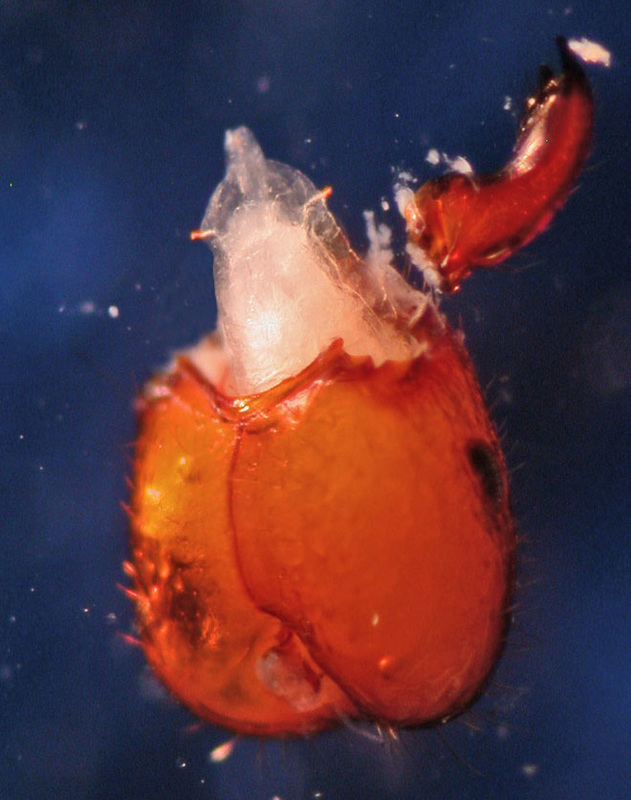
A fly maggot pushes away the mandibles and tongue apparatus to clear its eventual exit path. Image: S.D. Porter, USDA-ARS
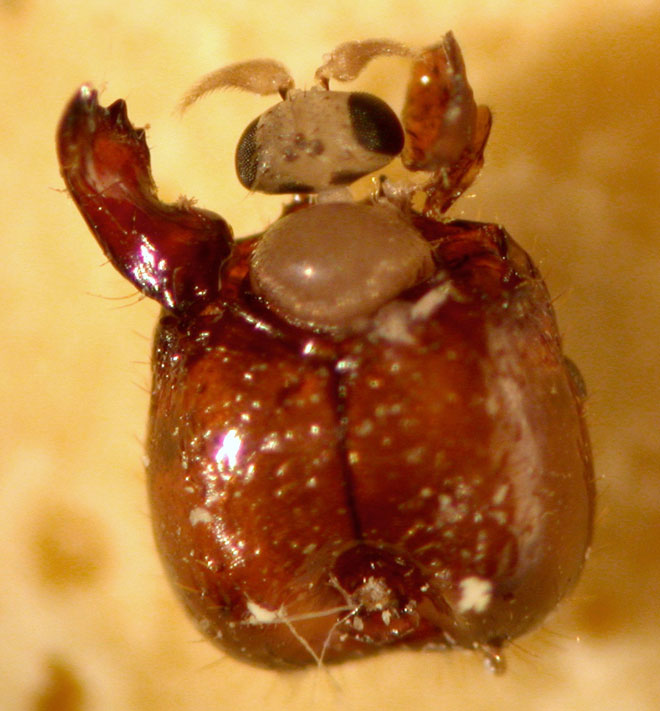
A newborn Pseudacteon litoralis male emerging from a fire ant's disembodied noodle. Image: S.D. Porter, USDA-ARS
A Pseudacteon litoralis female attempting to oviposit in a fire ant worker. Image: S.D. Porter, USDA-ARS
A Pseudacteon curvatus female with hook-shaped ovipositor. Image: S.D. Porter, USDA-ARS
Nature’s flying guillotines: the epically named ant-decapitating flies of the genus Pseudacteon. A tiny fly whose larvae burrow into ants, take control of their minds, and eventually sever their heads from the inside.

Attracted by the smell of the fire ant’s alarm pheromone, the female ant-decapitating fly hovers a few millimeters from her target. The fly has a sort of lock-and-key ovipositor, the shape of which varies widely between species, and once that’s fit onto the ant’s body, around the legs somewhere, then what happens is that there’s an internal ovipositor that looks like a hypodermic needle, and that hits probably in the membranes in between the legs,” firing a tiny torpedo-shaped egg into the ant.

In only a few days the egg grows considerably inside the ant before hatching. The resulting maggot works its way through the ant into its head, where it will live for several weeks on the host’s bodily fluids.

So, once the ant is in a suitable position, the maggot releases a chemical that dissolves the poor critter’s membranes, including the tissues that hold the head on. The ant’s noggin falls off, often leaving the body twitching behind. The larva next eats away the brains and muscles and glands, completely hollowing out the head. It then pushes in and out of the ant’s mouth to create an exit route, and begins to pupate.

Source: 
wired.com


Las ​guillotinas voladoras de la naturaleza: las épicas moscas parasitoides decapita- hormigas del género Pseudacteon. Una pequeña mosca cuyas larvas crecen dentro de las hormigas, toman el control de sus mentes, y eventualmente les cortan la cabeza desde el interior.

Atraídos por el olor de las feromonas de la hormiga de fuego, la hembra de la mosca decapita- hormigas cierne unos pocos milímetros de su objetivo. La mosca tiene una especie de ovipositor en forma de cerradura, cuya forma varía ampliamente entre especies y una vez que esto se ajusta sobre el cuerpo de la hormiga, acomodando las patas en algún lugar, el ovipositor interno que se parece a un aguja hipodérmica, y que probablemente de posiciona en las membranas entre las patas y dispara un pequeño huevo en forma de torpedo en la hormiga.

En sólo unos días el huevo crece considerablemente dentro de la hormiga antes de la eclosión. El gusano resultante se abre camino a través de la hormiga en la cabeza, donde vivirá durante varias semanas en los fluidos corporales del huésped.

Por lo tanto, una vez que la hormiga esta en una posición adecuada, el gusano libera una sustancia química que disuelve las membranas de la pobre creatura, incluyendo los tejidos que sujetan la cabeza .La cabeza de la hormiga se cae, a menudo dejando el cuerpo retorciéndose detrás. La larva próxima corroe el cerebro, los músculos y glándulas, por completo vaciando la cabeza. A continuación, la larva empuja por dentro y fuera de la boca de la hormiga para crear una ruta de salida, y comienza a pupar.

Fuente: wired.com
0 Comments


Leave a Reply.

    Blog Archive
    ​
    This blog isn't active anymore
    ​Disclaimer

    All the pictures on this blog and social networks belong to their respective authors and proper credits are given. Photos are used for illustrative and educational purposes only.

    Todas las fotografías de este blog y redes sociales son propiedad de sus respectivos autores, se mencionan los respectivos créditos. Estas fotos son únicamente utilizadas con fines ilustrativos y educativos.


    Archives

    March 2019
    January 2019
    December 2018
    November 2018
    October 2018
    August 2018
    May 2018
    April 2018
    March 2018
    February 2018
    August 2017
    July 2017
    June 2017
    May 2017
    January 2017
    December 2016
    October 2016
    August 2016
    July 2016
    June 2016
    May 2016
    April 2016
    March 2016
    February 2016
    January 2016
    December 2015
    November 2015
    October 2015
    September 2015
    August 2015
    July 2015
    June 2015
    May 2015
    April 2015
    March 2015
    February 2015
    January 2015
    December 2014
    November 2014
    October 2014
    September 2014
    August 2014
    July 2014
    June 2014
    May 2014
    April 2014
    March 2014
    February 2014
    January 2014
    December 2013
    November 2013
    October 2013
    September 2013
    August 2013
    July 2013
    June 2013
    July 2012

    RSS Feed

Powered by Create your own unique website with customizable templates.
  • Home
  • About
  • Blog
  • Videos
  • Podcast
  • Support
  • Press
  • Contact