|
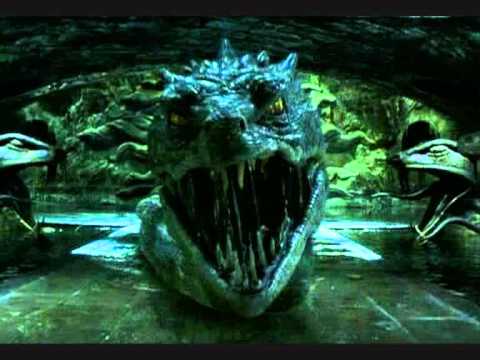
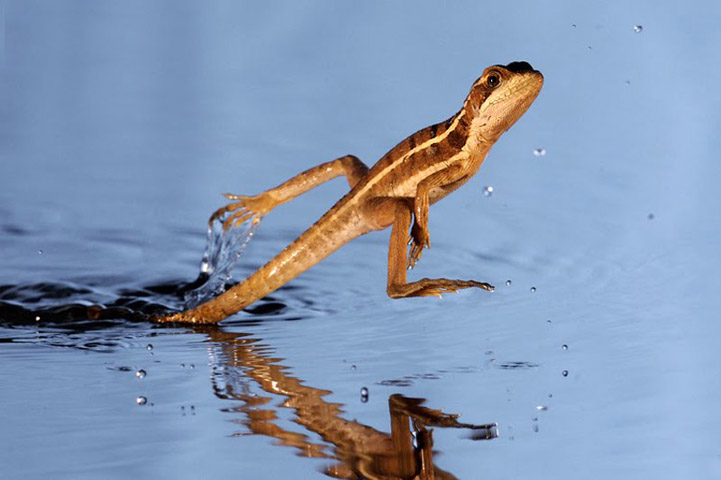
The Basilisk is a giant serpent bred by Dark Wizards. Herpo the Foul was the first to breed a Basilisk; he accomplished this by hatching a chicken egg beneath a toad which resulted in the creature known as a Basilisk. Although classified as an XXXXX creature, meaning it is a known wizard-killer that cannot be domesticated due to its immense powers, because the Basilisk is still a serpent, a Parselmouth may place a Basilisk under his or her control. This depends on the relationship between the Basilisk and the Parselmouth, as Tom Riddle alias Lord Voldemort, was the only one who could command Salazar Slytherin's Basilisk, while Harry Potter had no control over it. Basilisks can live a natural life of at least nine hundred years, though Salazar Slytherin's Basilisk lived for approximately a thousand years. This is accomplished by using Parseltongue to put the creature into a deep sleep that prevents it from aging, similar to suspended animation. Their mortal weakness is the crowing of a rooster. Basilisks feed off vertebrate animals and its venom is extremely toxic and so powerful that it can kill a person within minutes, making the person drowsy and blurry-visioned before they die, phoenix tears is the only known cure. In "Harry Potter and the Chamber of Secrets", the second book of the Harry Potter saga, Voldemort tries to kill Harry Potter by setting his basilisk snake on him. In the entire movie, Ron and Harry talk about the basilisk as if it is a huge snake but in real life basilisk's are quite different. 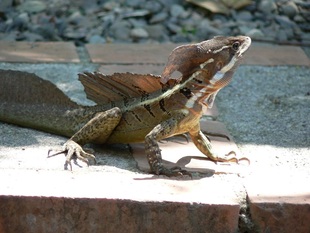 Photo: en.wikipedia.org Photo: en.wikipedia.org The common basilisk (Basiliscus basiliscus) is a lizard found in Central and South American rainforests near rivers and streams. The basilisk is part of the corytophanid family. It is also known as the Jesus lizard because when startled, escapes by speeding to the nearest edge of water and continues sprinting. The lizard runs on only its hind legs in an erect position, holding its fore legs to its sides. This basilisk is so adroit on water because its feet are large and equipped with flaps of skin along the toes. When moving quickly, the lizard can cross a surface of water before sinking. The common basilisk can be distinguished from similar species within its range by its large size and the high fin-like crests down its back. Most are brown and cream in colour. Males also have high crests on their heads and tails. Both sexes are brown to olive, and have a white, cream or yellow stripe on the upper lip and a second stripe along either side of their bodies. These stripes have higher contrast in juveniles and fade as the lizards age.
This basilisk is an omnivore. Its diet consists of insects, flowers, and small vertebrates such as snakes, birds, eggs, and fish. Source: harrypotter.wikia.com wiki/Common_basilisk The Reptile Database: reptile-database.org
0 Comments
Leave a Reply. |
Blog Archive
|


 RSS Feed
